
Physics A Level | Chapter 8: Electric current 8.5 Electrical resistance
If you connect a lamp to a battery, a current in the lamp causes it to glow. But what determines the size of the current? This depends on two factors:
the potential difference or voltage V across the lamp – the greater the potential difference, the greater the current for a given lamp
the resistance R of the lamp – the greater the resistance, the smaller the current for a given potential difference.
Now we need to think about the meaning of electrical resistance. The resistance of any component is defined as the ratio of the potential difference to the current.
This is written as:
$resistan ce = \frac{{potential\,difference}}{{current}} = R = \frac{V}{I}$
where R is the resistance of the component, V is the potential difference across the component and I is the current in the component.
You can rearrange the equation to give:
$I = \frac{V}{R}$ or $V = IR$
Table 8.2 summarises these quantities and their units.
Defining the ohm
The unit of resistance, the ohm ($\Omega $), can be determined from the equation that defines resistance:
$resistan ce = \frac{{potential\,difference}}{{current}}$
The ohm is equivalent to 1 volt per ampere:
| Quantity | Symbol for quantity | Unit | Symbol for unit |
| current | I | ampere (amp) | A |
| voltage (p.d., e.m.f.) | V | volt | V |
| resistance | R | ohm | $\Omega $ |
Questions
12) A car headlamp bulb has a resistance of $36\,\Omega $. Calculate the current in the lamp when connected to a ‘$12 V$’ battery.
13) You can buy lamps of different brightness to fit in light fittings at home (Figure 8.13). A ‘$100 watt$’ lamp glows more brightly than a ‘$60 watt$’ lamp. Explain which of the lamps has the higher resistance.
14) a: Calculate the potential difference across a motor carrying a current of $1.0 A$ and having a resistance of $50\,\Omega $.
b: Calculate the potential difference across the same motor when the current is doubled. Assume its resistance remains constant.
15) Calculate the resistance of a lamp carrying a current of $0.40 A$ when connected to a $230 V$ supply.
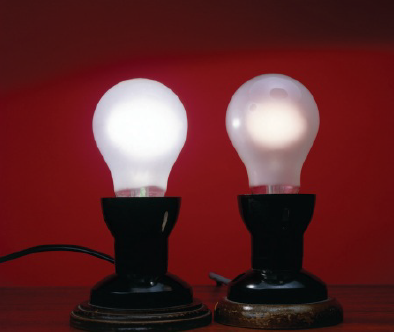
than the other. For Question 13
PRACTICAL ACTIVITY 8.1
Determining resistance
As we have seen, the equation for resistance is:
$R = \frac{V}{I}$
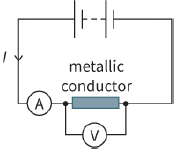
To determine the resistance of a component, we therefore need to measure both the potential difference V across it and the current I through it. To measure the current, we need an ammeter. To measure the potential difference, we need a voltmeter. Figure 8.14 shows how these meters should be connected to determine the resistance of a metallic conductor, such as a length of wire.
- The ammeter is connected in series with the conductor, so that there is the same current in both.
- The voltmeter is connected across (in parallel with) the conductor, to measure the potential difference across it.
Question
16) In Figure 8.14 the reading on the ammeter is $2.4 A$ and the reading on the voltmeter is $6.0 V$.
Calculate the resistance of the metallic conductor